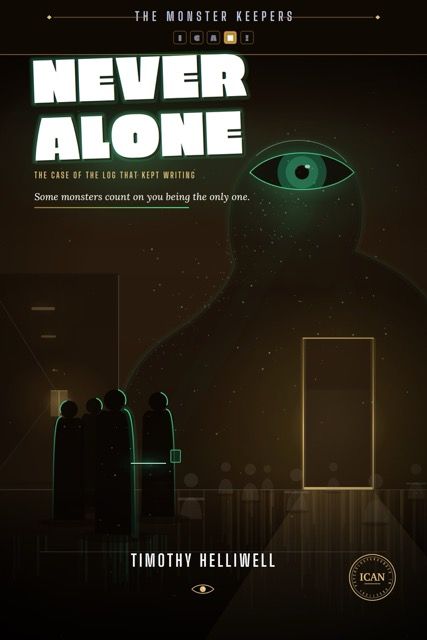
Some monsters count on you being the only one.
Never Alone
The Case of the Log That Kept Writing
Book Four of The Monster Keepers. The story starts at ten past eight in the morning, in a dark entrance hall, with four people standing over a book that none of them owns.
a novel by Timothy Helliwell
Grounded in ICAN Practical Psychology, created by Prof. CK Wong, JP.
The log that kept writing
08:10 · nobody owns this book · four of us
08:12 · two people, or it didn’t happen ·
Nobody in the crew wrote the second line.
Nothing writes in a book at night. That part is invented, and the book says so on its own page. What isn’t invented is set out on four plain pages inside it — one before the story starts, one in the middle of it, one after it ends, and the last page of all.
It plays fair. You can be ahead of them.
Never Alone is a detective story and is meant to be read as one. It plays fair: every clue the children use is on the page before they use it, and a reader who is paying attention can be ahead of them.
A girl in this book is missing for most of it. That part is invented. Out here, when somebody is missing it is a job for grown-ups and for the police, it starts straight away, and it is never a job for their friends.
The grown-ups in this book are real-sized on purpose. They turn up, they believe the children, they do the correct thing — and it is still not enough on its own, because there is one of them and a great many corridors.
A word that everybody says about you is not a fact about you. Whatever is going round, it is a thing people are saying. It is not a finding, and it is not you.
And nobody in this book gets through it on their own. From the book’s own real-life page
A record, not a verdict
Three columns, and no fourth
The front page of the crew’s file has three columns — the time, the words, and who was standing there — and no column for what anybody is like.
What an adult can act on
Ms. Okonkwo, the school librarian, reads a report standing up outside her office: give me a time and give me the words. Before she does anything else with it, she speaks to the person it happened to first, so that he does not find out about it sideways.
Somebody has to hold the other end
Early in the book Sam says that a thing is not true because somebody saw it — it is true when a second person can hold the other end of it.
Four pages step out of the story
One before it starts, one inside it, one after it ends, and the last page of all. They are set apart in the type, they are plain, and they are meant to be read as themselves.
Stand them in order and the spines spell it
I See YouBook 1
Out now. Book One of five, and the letter I.
Claim Your NameBook 2
Out now. Book Two, and the letter C.
Act NormalBook 3
Out now. Book Three, and the letter A.
Never AloneBook 4 · the one you are looking at
Book Four, and the letter N.
I Can!Book 5
Coming soon. Book Five, and the letter !.
Twelve chapters and four plain pages
Chapters
A detective story that plays fair. Every clue the children use is on the page before they use it.
Pages that step out
One before the story starts, one inside it, one after it ends, and the last page of all. Set apart in the type, and plain.
Columns in the file
The time, the words, and who was standing there. There is no column for what anybody is like, and that is the point of it.
Questions at the back
For teachers and book groups, with no right answers. A group that ends up disagreeing has done the work.
Three fears, braided together
Our own research with young readers found the same three fears braided together, again and again.
“If I tell, I’m a snitch — and it will only get worse.”
“No one will believe me, and even if they do, nothing will happen.”
“Maybe it’s me. Maybe there’s something wrong with me.”
From A Note from Prof. CK Wong, JP, printed in full at the back of this book.
“A child in that bind is not being difficult or secretive. They have done the arithmetic and concluded that silence is the safest option available to them.”
“So if you are the parent who found out late, or the teacher who sensed something and did not see it happen — please put down the guilt. You were not failing to notice. You were on the wrong side of a wall the child built for reasons that made sense to them.”
“Which is why this is not a parenting manual, and never pretends to be. It is a story — an adventure, told from a child’s point of view, that never lectures.”
“Read it with your child if they will let you; both the reading and the letting are victories.”
Prof. CK Wong, JP is a Specialist in Psychiatry, Honorary Clinical Professor and former Chairman of the Department of Psychiatry at the Faculty of Medicine, The Chinese University of Hong Kong, and a Fellow of the Royal College of Psychiatrists. He created ICAN Practical Psychology, which this series is grounded in. The author, Timothy Helliwell, writes the story; the psychology under it is Prof. Wong’s.
Knowing when to reach for help is itself one of the strongest moves there is.
Ask, and then wait
The front page of the crew’s file has three columns — the time, the words, and who was standing there — and no column for what anybody is like. Why do you think it is built that way?
The questions grown-ups actually ask
Do we have to have read the first three?
No. Never Alone stands on its own, and Sam will bring you up to speed early — mostly by getting something slightly wrong first and being corrected in capitals by Theo. If you would rather start at the beginning, Book 1 is I See You, and there is a link below.
Is it frightening?
It is a detective story with a monster in it, so it is tense the way a detective story is tense. It is not gory. The strange things the building does are strange rather than gruesome — and the book stops, on its own plain pages, to say out loud which parts are invented. Nothing writes in a book at night.
What are the four plain pages?
One before the story starts, one in the middle of it, one after it ends, and the last page of all. They are set apart in the type. The one inside the story sits between Chapter Six and Chapter Seven, at the hardest practical point in the book. The last page of all is the Help Page, and it lists real services, in a lot of countries.
What age is it for?
Ages 10 and up, twelve chapters. It is written to be read alone, aloud, or over a shoulder. Read it with your child if they will let you.
Does it teach, or does it just tell a story?
It tells a story. The method underneath it arrives sideways — from watching characters try things and get them wrong — and never from a box announcing what the lesson is. There is a separate section at the back, written for grown-ups, if you want the thinking set out plainly.
What if my child recognises too much of it?
Some children will recognise more of this book than they let on. Nothing in the questions at the back asks anybody to talk about their own experience in front of a group, and it is worth saying so out loud before you begin. If something real does surface, it belongs in a quiet conversation afterwards — and the last page of the book is where to go next.
Nobody in this book is taken out of existence, and nobody can be. Every register in that building still has her name on it, and she is herself the whole way through. However loud a thing about you gets, it does not delete you. It cannot. There is no such thing. There is always another one.
Start with the free sample. Ten past eight in the morning, a dark entrance hall, and four people standing over a book that none of them owns.
Grounded in ICAN Practical Psychology, created by Prof. CK Wong, JP. If somebody is hurting your body, threatening you, taking your things, or making you frightened to walk down a corridor, that is not yours to sort out on your own — tell a trusted adult today. The Help Page at the back of this book lists real services, in a lot of countries, whose whole job is this. If you are in danger right now, call your local emergency number. ISBN 978-988-8171-67-5 · micancapital.com · © 2026 MICAN CAPITAL LIMITED
ICAN Practical Psychology Model
For over two decades, Prof. CK Wong has been dedicated to sharing this knowledge across all sectors of society in the Greater Bay Area in Asia through various mental health education programs, methods, and tools based on the ICAN Model. His goal has been to make mental health education accessible to more people, thereby improving the overall psychological wellbeing of society.
Throughout this period, Prof. CK Wong has provided mental health education to more than 400,000 adults and students in the Greater Bay Area through various programs.
24-hour Emotional and Suicide Crisis Support Hotline
The Samaritans of Hong Kong: 2389 2222
Crisis Support Service
Caritas Heung Ching Yuen: 18288
Tung Wah Group of Hospitals Chi Yuk Garden Hotline: 18281
Mental Health Hotline
Hospital Authority 24-hour Psychiatric Telephone Consultation Service: 2466 7350
Hospital Authority Psychiatric Disorder Hotline: 2928 3283
Social Welfare Department: 2343 2255
ICAN Mental Education
Empowering You and Your Family to Live Well!
Living well is not easy for most people, whether as individuals or within workplaces, schools, families, or as parents. "ICAN Mental Education" empowers everyone to harness their "brain power", "mind power", and "life power", enabling you to live well, maintain physical and mental health, enjoy a happy family life, and achieve success in your work and career!
We have developed "ICAN Mental Education" as a video course. The Cantonese version is now available, and the Mandarin and English versions will be launched in early 2025, each featuring over 500 videos.
We warmly invite you to become an "ICAN Premium Member". By dedicating just five minutes a day to studying our online "ICAN Mental Education" and consistently reflecting, awakening, and practicing, I am confident you can live a fulfilling life. If you are a parent, I believe your growth will also inspire your children to thrive.
If you have any inquiries, you are welcome to contact us at any time .
I wish you a fulfilling life, robust physical and mental health, a happy family, and a successful career!
Professor CK Wong, JP
Sign-up, log-in, payment details and contents apply only to the English version. You must register separately for other languages of ICAN Live Well.
You are about to enter
ICAN Live Well (English)
Your sign-up, log-in, subscription, payment details, and all ICAN Mental Education access here will all be specific to and solely for the ICAN Live Well (English).
You MUST create a separate account, and either subscribe yourself or be registered by your employer to access another language of ICAN Live Well.
You are about to enter
ICAN Live Well (粵語)
Your sign-up, log-in, subscription, payment details, and all ICAN Mental Education access here will all be specific to and solely for the ICAN Live Well (粵語).
You MUST create a separate account, and either subscribe yourself or be registered by your employer to access another language of ICAN Live Well.
You are about to enter
ICAN Live Well (普通話)
Your sign-up, log-in, subscription, payment details, and all ICAN Mental Education access here will all be specific to and solely for the ICAN Live Well (普通話).
You MUST create a separate account, and either subscribe yourself or be registered by your employer to access another language of ICAN Live Well.
“80-Day Mental Health Journey” Overview
The “80-Day Mental Health Journey” consists of 80 Steps in five Stages. I recommend completing one step per day.
By applying the three principles of “Reflection, Awakening, and Practice”, I am confident that by the end of this journey, you will:
- Strengthen your mental health;
- Achieve three priceless treasures in life: physical & mental well-being, family happiness, and professional success
You will also earn two Certificates of Completion of ICAN Mental Education.
Below is an overview of the 80-Day Mental Health Journey:
FIRST PHASE:
Step 1: Subscribe to “ICAN Premium Member”.
Step 2: Assess your current mental health status.
Stage One: After Step 2, you will understand your mental health baseline. No matter your starting point, continuing this journey will transform your mental health from "unwell to well" or "good to better!"
SECOND PHASE:
Steps 3 to 12:
Understanding Mental Health and The ICAN Mental Education Program
(Each step requires ~10 minutes)
Stage Two: Upon completing Step 12, you will deeply appreciate the importance of mental health and how ICAN Mental Education empowers you to strengthen it while unlocking life’s three treasures.
THIRD PHASE:
Steps 13 to 24:
Activate Your Mental Power
(Each step requires ~5 minutes)
Stage Three: By completing Step 24, through consistent Reflection, Awakening, and Practice, you will unlock your inner Mental Power and witness progress in your mental health.
You will be awarded a Certificate of Completion of “ICAN Mental Education – 1st Term”.
FOURTH PHASE:
Steps 25 to 48:
Continuously Unlock Mental Power -
Master Methods to Harness Brain Power, Mind Power, and Life Power
(Each step requires ~5 minutes)
Stage Four: Upon completing Step 48, you will master methods to continuously unlock Brain Power, Mind Power and Life Power by consistent Reflection, Awakening, and Practice. You will also witness the continuous advancement of your mental health.
FIFTH PHASE:
Steps 49 to 80:
Continuously Unlock Mental Power - Achieve Life’s Three Treasures
(Each step requires ~5 minutes)
Stage Five: You will complete the 80-Day Mental Health Journey, having:
- Strengthened your mental health;
- Attained physical & mental well-being, family happiness, and professional success; and
- Gained the ability to positively influence your loved ones, friends and colleagues, and enabled them to live well.
You will also receive a Certificate of Completion of “ICAN Mental Education” - Final Term, recognizing your commitment to mental health and mastery of the ICAN methodology.